Every Group with Homogeneous Composition Factors Satisfies the Herzog–Schönheim Conjecture
One simple composition factor is enough
R005 · Novelty unconfirmed
The setting
A coset partition of a finite group \(G\) is an exact cover \(G = D_1 \sqcup \dots \sqcup D_k\) by pairwise disjoint cosets \(D_i = x_iH_i\) of subgroups \(H_i \le G\), with pairwise distinct sizes when the \(|D_i| = |H_i|\) differ, and nontrivial when \(k \ge 2\). A group with no such partition is called HS, after the Herzog–Schönheim conjecture, which asserts that every finite group is HS. The conjecture is open [5]; it is known for supersolvable groups, for groups of order below 1440 [6], and for all finite simple and symmetric groups [1].
This page is about the composition factors. R003 settled groups whose composition factors are all \(A_5\) or \(C_5\); R004 settled extensions of \(A_5\) by a normal \(p\)-subgroup. The question here is the general one: if every composition factor of \(G\) is isomorphic to a single fixed simple group \(S\), is \(G\) HS?
The criterion this rests on
For a finite simple group \(S\) write
\[I(S) = \{\text{distinct proper subgroup indices}\}, \qquad D(S) = \sum_{n \in I(S)} \frac1n = \mathcal J(S) - 1, \qquad m(S) = \min I(S),\]
let \(M(S)\) be the multiplicative monoid generated by \(I(S)\), and put
\[\Lambda(\{S\}) = \sum_{m \in M(S),\, m > 1} \frac1m .\]
Theorem (index-monoid criterion). If \(\Lambda(\mathcal S) < 1\) for a finite set \(\mathcal S\) of finite simple groups, then every finite group whose composition factors lie in \(\mathcal S \cup \{C_p : p \in M(\mathcal S)\}\) is HS.
Proof. Three steps, complete.
- Indices live in the factor monoid. For \(N \trianglelefteq G\) and \(H \le G\) one has \([G:H] = [G/N : HN/N]\cdot[N : N \cap H]\), so \(I(G) \subseteq \langle I(N) \cup I(G/N)\rangle\) in the multiplicative monoid generated by the two index sets — the factors are manifestly there, and the case \(HN = G\) is the factor \(1\). Inducting along a composition series, \(I(G) \subseteq M(\mathcal S)\): a nonabelian factor contributes the indices of a group in \(\mathcal S\), and a cyclic factor \(C_p\) contributes its index \(p\), which is in \(M(\mathcal S)\) by hypothesis.
- Count reciprocals. A coset partition into \(k \ge 2\) blocks satisfies \(\sum_i 1/n_i = 1\) for the block indices — every point is counted once, and each block of size \(n_i\) contributes \(1/n_i\). With pairwise distinct indices \(n_i > 1\) this gives \(1 \le \sum_{m \in I(G),\, m>1} 1/m \le \Lambda(\mathcal S) < 1\), a contradiction.
- Nothing depends on the group. Only the composition factors entered, so the bound is uniform over every \(G\) with those factors. \(\square\)
The criterion is the one R003 states and uses; the underlying reciprocal-sum identity is Korec and Znám’s [2], the criterion \(\mathcal J(G) < 2\) is Lemma 2.1(1) of Garonzi–Margolis [1], who credit the idea for \(A_5\) to Ginosar and Schnabel [3], and the monoid refinement is R003’s.
The theorem
Theorem 1 (Homogeneous composition factors) Let \(S\) be a finite nonabelian simple group. Then every finite group whose composition factors are all isomorphic to \(S\) satisfies the Herzog–Schönheim conjecture.
The four classical groups that once stood outside this statement — \(\mathrm{PSL}(4,4)\), \(P\Omega(13,3)\), \(P\Omega^+(14,2)\), \(P\Omega^-(14,2)\) — are no longer exceptions: each now carries a certificate for \(\Lambda(\{S\}) < 1\) in the record. They were never counterexamples, only cases where the imported inequalities are lossy at the sharpened threshold and no exact computation finished inside its cap. What the theorem needs is \(\Lambda(\{S\}) < 1\), and that is what the audit establishes, family by family.
How the finite part is closed
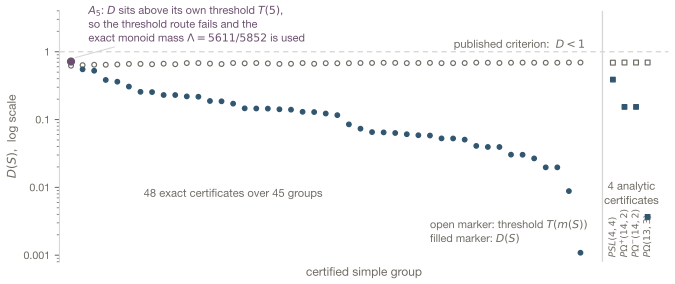
Everything reduces to one number per simple group. The published criterion needs \(D(S) < 1\); the audit uses the sharper
\[D(S) \;<\; T(m(S)) \;:=\; \frac{\log 2}{-m \log(1 - 1/m)},\]
which implies \(\Lambda(\{S\}) < 1\) because \(\log(1 + \Lambda(S)) \le c_m D(S)\) with \(c_m = \sum_{j\ge1} 1/(j\,m^{j-1})\), and \(c_m T(m) = \log 2\). For the per-group certificates and the \(\mathrm{PSL}(2,q)\) family the threshold is computed as an exact rational lower bound, so those comparisons are exact; the classical-family cutoffs below are evaluated in double precision with a safety margin far below every margin that survives.
With that threshold the audit closes every family:
- alternating groups, all \(n\): \(D(A_n) < 1/3\) against \(T(n) \ge T(9) = 0.6539\);
- sporadic groups, all 27: the paper’s \(B_n\) bound [1] covers 25, and \(M_{12}\), \(M_{22}\) carry exact certificates;
- exceptional Lie type, all ten families: certified at the minimal parameter of each, empty residual;
- classical Lie type: certified at each family’s first passing \((n,q)\) — the scan stops at the first success, and the tail beyond it rests on the imported bounds [1] rather than on a machine check. The 62 pairs below the cutoffs become 65 group entries, two of which (\(PSU(3,2)\) and \(PSp(4,2) \cong S_6\)) are not simple; of the other 63, 59 are certified — 26 from an earlier sweep, 20 by exact subgroup lattice, 13 by an upper bound from maximal-class data — and the remaining four are certified analytically: the three orthogonal groups from Lemma 4.3 of [1] with its bound on the number of maximal-subgroup orders replaced by the divisor bound \(\tau(|G|)\), and \(\mathrm{PSL}(4,4)\) from the paper’s own \((4,4)\) data \(\ell \le 9\), \(m_1 = 85\). No entry of the residual is left open;
- \(\mathrm{PSL}(2,q)\), every prime power \(q \le 20000\): a closed-form certificate from Dickson’s classical description of the maximal subgroups of \(\mathrm{PSL}(2,q)\), including the subfield classes, with \(q \in \{5,7,8,9,11\}\) settled by explicit lattice computation. (The audit also reports an extended run to \(q \le 200000\); that run’s artifact is not archived, so this page claims only the archived range.)
Finitely many groups are checked directly: 48 certificates, over 45 distinct groups, built from GAP-computed index sets — \(A_5 \cong \mathrm{PSL}(2,5)\), \(A_6 \cong \mathrm{PSL}(2,9)\) and \(A_8 \cong \mathrm{PSL}(4,2)\) are each represented by two isomorphic certificates. The figure shows those 48 exact certificates, and the four analytic closures, against their thresholds.
What it does not settle
- What the four closures import. The three orthogonal certificates use Lemmas 4.1, 4.2, 4.3 and 4.5 of [1] as they stand, including the minimal-index bound \(m_1 \ge q^{n-2}\) of their Table 2 (values computed by Cooperstein, compiled by Mazurov and Vasil’ev). The \(\mathrm{PSL}(4,4)\) certificate uses the paper’s own \((4,4)\) count \(\ell \le 9\), read there from the tables for \(L_4(q)\) in [4], with \(m_1 = 85\). Those tables are not re-derived here. The \(\mathrm{PSL}(4,4)\) bound is linear in \(\ell\) and tolerates \(\ell \le 14\); the coarser fallback that uses no class list at all tolerates \(\ell \le 11\).
- One computer algebra system. The index sets of the non-\(\mathrm{PSL}(2,q)\) groups come from GAP alone. The \(\mathrm{PSL}(2,q)\) family has an independent Dickson-based route with no disagreements, and \(A_5\) and \(\mathrm{PSL}(2,7)\) were done by hand, but the rest are single-source.
- The large sporadics are certified from tabulated maximal-subgroup data [1] rather than a local computation.
- Mixed composition factors. Products of different simple groups are outside the theorem, and the criterion does not extend to them: composition factors \(A_5\) and \(C_2\) together already break it, since \(\mathcal J(A_5 \times C_2) = 55/24 > 2\) and \(2 \notin M_5\).
- The general conjecture, and the solvable case. Both remain open; for solvable groups this criterion says nothing, because their order spectrum is dense and the reciprocal sums are large.
- Novelty. No prior statement of the homogeneous-composition-factor form was located. The imported bounds are Garonzi–Margolis’s [1]; what is new here is the sharper threshold, the sharpening of their tabulated cutoffs, the divisor bound that closes the three orthogonal groups, the closed-form \(\mathrm{PSL}(2,q)\) family, and the assembly.
Verification
The record’s evidence for this page is the audit’s own output: hsc-audit/ in the private technical record, where run_all.sh reproduces everything deterministically and every computation cap is enforced inside Python — a capped run is recorded as timeout, never as a certificate. The per-group certificates and the \(\mathrm{PSL}(2,q)\) closed form use exact rational arithmetic; the classical-family cutoffs use double precision with a relative safety margin, as noted above. One JSON certificate per group, the family layers’ summaries, and a separate Dickson-based cross-check of all 46 \(\mathrm{PSL}(2,q)\) certificates with zero disagreements are all archived. The four former exceptions carry certificates in the audit’s certificate format, and no computation cap is load-bearing for them: the \(\mathrm{PSL}(4,4)\) class data was measured in a capped GAP run, and a coarser bound needing no class list gives the same verdict. The audit’s acceptance table, with every attempted constructor and its status, is §5 of its final report; the four former open entries are §8.5 and their closure is §8.8.
The criterion itself is not machine-checked here: it is proved in the Proof above, with the reciprocal-sum identity from [2] and the criterion from [1]. What the computation supplies is \(\Lambda(\{S\}) < 1\) for each \(S\).
References
- M. Garonzi, L. Margolis, The Herzog–Schönheim conjecture for simple and symmetric groups, arXiv:2509.25118v2 (2026). Lemma 2.1(1) (the \(\mathcal J < 2\) criterion), Lemma 2.3 and Table 1 (the \(B_n\) bound and the sporadic data), Props. 3.2 and 4.6–4.8 with Tables 2–3 (the family cutoffs).
- I. Korec, Š. Znám, On disjoint covering of groups by their cosets, Math. Slovaca 27 (1977) 3–7.
- Y. Ginosar, O. Schnabel, Prime factorization conditions providing multiplicities in coset partitions of groups, J. Comb. Number Theory 3 (2011) 75–86.
- J. N. Bray, D. F. Holt, C. M. Roney-Dougal, The maximal subgroups of the low-dimensional finite classical groups, London Mathematical Society Lecture Note Series 407, Cambridge University Press (2013) — the tables for \(L_4(q)\) are the source of the count \(\ell \le 9\) used at \(\mathrm{PSL}(4,4)\).
- Erdős Problems #274, erdosproblems.com/274 — the conjecture listed as open.
- L. Margolis, O. Schnabel, The Herzog–Schönheim conjecture for small groups and harmonic subgroups, Beiträge zur Algebra und Geometrie 60 (2019) 399–418, arXiv:1803.03569 — the case \(|G| < 1440\).
How to cite
Steps Unbounded, Every Group with Homogeneous Composition Factors Satisfies the Herzog–Schönheim Conjecture, R005, 2026. https://stepsunbounded.com/results/R005/
@misc{stepsunboundedR005,
  author = {{Steps Unbounded}},
  title  = {Every Group with Homogeneous Composition Factors Satisfies the Herzog--Sch{\"o}nheim Conjecture},
  year   = {2026},
  note   = {Result R005, Steps Unbounded},
  url    = {https://stepsunbounded.com/results/R005/}
}