Private Points Imply Herzog–Schönheim, and the Solvable Case Reduces to Linear Independence
Two reductions, and the capacity sieve as the published criterion plus lower rows
R006 · Novelty unconfirmed
The setting
A coset partition of a finite group \(G\) is an exact cover \(G = D_1 \sqcup \dots \sqcup D_k\) by pairwise disjoint cosets of subgroups, with pairwise distinct sizes when the \(|D_i|\) differ. A group with no such partition is HS, after the Herzog–Schönheim conjecture. R003 gave a criterion in terms of a monoid of subgroup indices, R004 a lifting theorem for normal \(p\)-subgroups; this page records two reductions that place both, and the published criterion, in one frame.
A point \(g \in G\) is private to a member \(D\) of a family of cosets if \(g \in D\) and \(g\) lies in no other member. Say \(G\) has PP if every nonempty family of cosets with pairwise distinct sizes has a member with a private point. And say \(G\) has \(LI_p\) if for every family \(D_1, \dots, D_t\) of distinct cosets with pairwise distinct sizes, the indicator functions \(\mathbf 1_{D_1}, \dots, \mathbf 1_{D_t}\) are linearly independent over \(\mathbb F_p\).
Private points imply the conjecture, with no lifting
Proposition 1 (PP implies HS) If a finite group \(G\) has PP, then \(G\) is HS.
Proof. Suppose \(G = D_1 \sqcup \dots \sqcup D_k\) is a partition into \(k \ge 2\) pairwise disjoint cosets of pairwise distinct sizes. Adjoin \(G\) itself to the family. The sizes stay pairwise distinct, no \(D_i\) has a private point, because every point of \(D_i\) also lies in \(G\), and \(G\) has no private point, because the \(D_i\) already cover \(G\). So PP fails. Contrapositive. \(\square\)
PP also gives \(LI_p\) for every prime \(p\) at once — a private point kills its coefficient in any \(\mathbb F_p\)-relation — so PP is a further sufficient condition for HS, whose capacity sieve contains the counting criterion of [1] as its top row. Whether PP is strictly stronger than that criterion is not settled here: what is settled is that PP implies HS, and that the sieve tests PP row by row.
The capacity sieve is the published criterion plus lower rows
R004’s capacity sieve: if a family of cosets with pairwise distinct sizes has a largest member \(D\) of size \(S\) with no private point, then
\[S \;\le\; \sum_{m<S} c_G(S,m), \qquad c_G(S,m) = \max\{|K \cap L| : |K| = S,\ |L| = m\}.\]
Proposition 2 (The top row is \(\mathcal J(G) < 2\)) At \(S = |G|\) the sieve condition reads \(\mathcal J(G) < 2\): it is the published criterion of Korec and Znám [2], restated as Lemma 2.1(1) of [1].
Proof. The only subgroup of order \(|G|\) is \(G\) itself, so \(c_G(|G|, m) = |G \cap L| = m\) for every proper order \(m\) that occurs. Distinct subgroup orders correspond to distinct indices, so
\[\sum_{m<|G|} c_G(|G|,m) \;=\; \sum_{\text{proper orders } m} m \;=\; |G|\,\bigl(\mathcal J(G) - 1\bigr),\]
and the sieve condition \(|G| > \sum_{m<|G|} c_G(|G|,m)\) becomes \(\mathcal J(G) < 2\). \(\square\)
The identity is checked exactly on five groups — capacity sum against \(|G|(\mathcal J(G)-1)\): \(A_5\) \(43 = 43\), \(\mathrm{PSL}(2,7)\) \(88 = 88\), \(A_6\) \(198 = 198\), \(M_{11}\) \(2424 = 2424\), \(\mathrm{PSL}(2,8)\) \(128 = 128\). So PP is sufficient for HS, the sieve is a finite test for PP, and its top row is the classical criterion: R003’s monoid reading and the published criterion sit inside one framework. What the sieve adds is the rows below the top one — and a lattice-free shortcut \(c_G(S,m) \le \gcd(S,m)\) certifies nothing on its own: run against all 114 groups for which the audit of R005 holds exact index data, it certified none of them (an empirical statement, not a no-go theorem).
The solvable case reduces to linear independence
Theorem 1 (Reduction to \(LI_p\)) If \(LI_p(Q)\) holds for every finite solvable group \(Q\) and every prime \(p\), then every finite solvable group is HS.
Proof. A nontrivial finite solvable group \(G\) has a minimal normal subgroup \(V\), and every minimal normal subgroup of a solvable group is elementary abelian — so \(V\) is a normal \(p\)-subgroup for some prime \(p\), with the hypothesis of R004’s lifting theorem free. The quotient \(G/V\) is solvable, so \(LI_p(G/V)\) holds by hypothesis, and the lifting theorem gives that \(G\) is HS. No induction is needed: the hypothesis is stated uniformly, for every finite solvable group. \(\square\)
The direction is what makes the induction work: the lifting theorem ascends HS and not \(LI_p\), so each step needs \(LI_p\) of a smaller quotient, never of \(G\) itself. R004’s page lists “the theorem ascends the conjecture, not \(LI_p\)” among its limitations; it is the solvable case, stated precisely.
What is unconditional here, and what is not. This is a complete proof of an implication, and no step assumes the hypothesis. What is open is the hypothesis itself for arbitrary solvable groups. The sentence that would make the conjecture’s hard case unconditional — every finite solvable group is HS — is a corollary of this theorem and stays conditional on \(LI_p\) until the hypothesis ceases to be one.
The hypothesis can be weakened to \(H_p\). Say \(H_p(Q)\) holds when no nonempty family of distinct cosets of \(Q\) with pairwise distinct sizes satisfies \(\sum_i \mathbf 1_{D_i} = 0\) in \(\mathbb F_p[Q]\) — equivalently, no such family covers every point a multiple of \(p\) times. Then
- \(LI_p \Rightarrow H_p\), and private points \(\Rightarrow H_p\), because a point covered exactly once contributes \(1 \not\equiv 0\);
- \(H_p(Q) \Rightarrow Q\) is HS, because the contradiction R004’s lifting proof produces is a relation whose coefficients are all \(1\): that proof never needed full linear independence, only the absence of these all-ones relations.
So the theorem above holds with \(H_p\) in place of \(LI_p\) — the weaker hypothesis, and the one the lifting argument actually consumes. This page states the reduction in its published \(LI_p\) form and records the sharpening here.
Two lemmas would make the corollary unconditional.
- Lemma A (abelian). \(H_p(A)\) for every finite abelian \(A\) and every prime \(p\) — equivalently \(LI_p(A)\). Partly proved. The \(p\)-group case is now a theorem, for arbitrary finite \(p\)-groups, abelian or not: if a family is a relation, take a member \(D_1\) of largest size \(p^a\); no point of \(D_1\) is private, and distinct sizes make every other size a smaller power of \(p\), so \(p^a \le \sum_{j\ge2}|D_j| \le 1+p+\dots+p^{a-1} < p^a\). What is open therefore sits in groups with at least two prime factors, and there the case has one shape left — the paragraph after the lemmas. The obstruction is concrete: restricting a family to a subgroup loses distinctness of sizes, since two subgroups of different orders can meet a fixed subgroup in the same order — in \(C_2 \times C_2 \times C_4\) with \(N = \{0\} \times \{0\} \times C_4\), subgroups of orders \(2\) and \(4\) both meet \(N\) in order \(2\).
- Lemma B (ascension). If \(V \trianglelefteq G\) is a normal \(p\)-subgroup and \(H_p(G/V)\) holds, then \(H_p(G)\) holds. Partly proved, and the crux: with Lemma A it gives \(H_p\) for every finite solvable group, hence the corollary. Summing a relation over a coset of \(V\) is a linear map, and it sends the member \(D_i\) to \(|H_i \cap V|\) times the indicator of a coset of \(G/V\). Since \(|H_i \cap V|\) is a power of \(p\), every member whose subgroup meets \(V\) in more than the trivial subgroup vanishes modulo \(p\); if some member meets \(V\) trivially, the survivors are an all-ones relation on \(G/V\) among cosets of pairwise distinct sizes, contradicting \(H_p(G/V)\). That is the case proved. What remains is the case where every member meets \(V\) in a subgroup of order divisible by \(p\): then every member descends to the zero element of \(\mathbb F_p[G/V]\) and the descended relation reads \(0 = 0\), so this summation cannot settle it. That case is not vacuous — on \(V = C_2 \times C_2\) at \(p = 2\), the cosets \(\{e,a\}, \{e,b\}, \{a,c\}, \{b,c\}\) cover every point exactly twice — and it includes every family with a member whose subgroup contains \(V\). No counterexample family was found, and the case is not closed.
Where the hypothesis stands now. Three things follow from that work. The hypothesis cannot fail in a \(p\)-group: \(H_p\) holds for every finite \(p\)-group, so a counterexample needs at least two prime factors. In the abelian case a smallest counterexample must have every size divisible by \(p\), no prime \(\ell\) for which all sizes share one \(\ell\)-valuation, and in the cyclic case a collision pair \(\{M, \ell M\}\) with \(\ell \nmid M\) for every prime \(\ell \mid n\) — in particular \(4 \mid n\) whenever \(2 \mid n\). And in that cyclic case at \(p = 2\), a counterexample is exactly a nonempty system of residue classes with pairwise distinct moduli in which every integer is covered an even number of times: an explicit system of that kind would refute the case, and none exists for any \(n \le 227\), though none is proved absent. Proof and range, not proof of the hypothesis: the corollary above stays conditional.
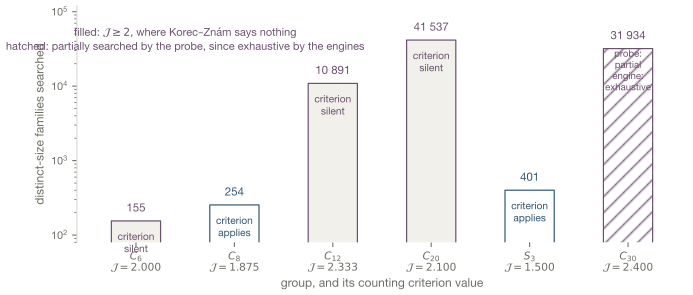
The hypothesis is not a restatement of the counting criterion. Since \(\mathcal J(C_n) = \sigma(n)/n\), the criterion of [1,2] is silent (or fails) exactly when \(\sigma(n) \ge 2n\), and the first probe checks \(LI_p\) directly, by exact \(\mathbb F_p\) linear algebra over every distinct-size coset family:
| group | \(\mathcal J\) | criterion | \(LI_p\) for \(p =\) | families |
|---|---|---|---|---|
| \(C_6\) | 2.000 | silent (boundary) | 2, 3, 5 | 155 E |
| \(C_8\) | 1.875 | applies | 2 | 254 E |
| \(C_{12}\) | 2.333 | silent | 2, 3 | 10 891 E |
| \(C_{20}\) | 2.100 | silent | 2, 5 | 41 537 E |
| \(S_3\) | 1.500 | applies | 2, 3 | 401 E |
| \(C_{30}\) | 2.400 | silent | 2, 3, 5 | now exhaustive |
E = every distinct-size coset family enumerated.
The hypothesis has since been searched as far as is reachable here: \(LI_p\) holds for every solvable group of order \(\le 47\) and every prime dividing its order — 308 tests over the 197 solvable groups of that range, 869 321 search nodes, no dependence and no cap. The search is a complete depth-first enumeration over the distinct subgroup orders, at most one coset per size, exact over \(\mathbb F_p\), with conservative prunes. A family here means a family of distinct cosets of \(Q\) with pairwise distinct sizes, the whole-group coset \(Q\) included: that is the form R004’s lifting proof uses, and an earlier engine had excluded it, which is strictly weaker. Beyond order 47 the search is not contiguous: 356 tests over 223 solvable groups in total, orders 2 to 126, 1 998 911 nodes, with no dependence and no cap anywhere — the two tests that once hit the node budget were re-run to completion. Orders 2 to 47 and 121 to 125 are complete, order 48 (8 of its 52 solvable groups) and order 126 (4 of its 16) are partial, and orders 49 to 120 are untested. \(C_{30}\) is exhaustive under both protocols, which supersedes the partial row above.
Three further searches push into the directions where a counterexample can hide. \(H_p(C_n)\) is verified for every \(n \le 227\) and every prime \(p \le 13\) except ten tests at \(p = 2\), namely \(n\) = 96, 120, 144, 160, 168, 180, 192, 200, 216 and 224, each capped and recorded as a cap rather than a verification. \(H_p(A)\) is verified for every abelian group of order \(\le 60\) except eight tests, again all at \(p = 2\). And on the small non-\(p\)-groups where the ascension’s remaining case can bite, the relation count is zero over every family, not a sample: \(C_{48}, C_{54}, C_{60}, C_{72}, C_{84}, C_{90}\) at \(p = 2\), \(C_{30}, C_{48}, C_{54}\) at \(p = 3\), and \(A_4 \times C_5\) of order 60 and \(A_4 \times C_7\) of order 84.
What it does not settle
- The hypothesis is open beyond what is proved. \(LI_p\) for every finite solvable group is not known here, and neither is the weaker \(H_p\); the \(p\)-group theorem is the only part that is proved. What is settled is a range: every solvable group of order \(\le 47\), every prime dividing its order, plus the cyclic and abelian ranges above and the small non-\(p\)-groups listed there. \(LI_p\) is strictly stronger than HS, so a single solvable group that is HS but not \(LI_p\) kills this route while leaving the conjecture untouched, and the failure branch is untested beyond the range.
- The range is an experiment, not a theorem. A completed search is exhaustive for its group and prime, so each
HOLDSis a proof for that pair; the range statement is finite evidence, not a proof of the hypothesis. The two tests that hit the node budget at order 48 were rerun with a larger budget and both returnedHOLDS. Caps are recorded as caps and never as verifications: ten cyclic tests at \(p = 2\) and eight abelian ones, both listed above. - The hazard sits in the extensions. Whether \(LI_p\) ascends through extensions is what the withdrawn announcement of [3] ran into — its withdrawal note says the case where a subgroup maps to a full copy of \(\mathbb Z_p\) under the quotient “is not trivial and must be considered more carefully”. The reduction here does not need \(LI_p\) to ascend: the lifting theorem only ever asks for \(LI_p\) of the quotient.
- The framework is counting-flavoured. For solvable groups the subgroup-order spectrum is dense and every capacity sum is large, so the sieve says nothing there; the two propositions do not touch the hard case, and the reduction only reformulates it.
- Novelty. No prior statement of either reduction was located; \(LI_p\) and the private-point property are used here as named hypotheses rather than as established notions.
Verification
Both results come with machine-checked tables, and both statements are proved above rather than computed. capacity_sieve.py and li_p_probe.py in the private technical record are pure Python, exact throughout — integer Gaussian elimination modulo \(p\) for the independence tests, Fraction for the index sums — and exit non-zero on disagreement; both run under the audit’s deterministic run_all.sh. They reproduce the five-group top-row table, the 114-group shortcut test, the \(J(C_n) = \sigma(n)/n\) checks and the probe table above. The extended search is carried by the GAP engines li_p_group.g and li_p_fast.g with the aggregators li_p_group_aggregate.py / li_p_aggregate.py; every verdict is exact integer modular linear algebra, a completed search is exhaustive for its group and prime, and a budget cap is recorded as a cap, never as a verification. The later development of the two lemmas, and the three ranges quoted above, are carried by three documents in the private technical record — hsc-audit/theory/proof_lemma_A.md, hsc-audit/theory/proof_lemma_B.md and hsc-audit/theory/lift_gap_findings.md with its engine hsc-audit/scripts/lift_gap_check.py — in exact integer and mod-\(p\) arithmetic, no floating point, fixed enumeration order, and the same rule for caps. The trace identity that the ascension turns on was re-checked separately, in GAP, against every subgroup, normal subgroup and coset of every group of order at most 16: 620 136 cases, no disagreement.
References
- M. Garonzi, L. Margolis, The Herzog–Schönheim conjecture for simple and symmetric groups, arXiv:2509.25118v2 (2026). Lemma 2.1(1) is the \(\mathcal J < 2\) criterion used above.
- I. Korec, Š. Znám, On disjoint covering of groups by their cosets, Math. Slovaca 27 (1977) 3–7 — the reciprocal-sum identity behind that criterion.
- M. C. Burkhart, The Herzog–Schönheim conjecture for solvable groups, arXiv:1901.10131 — withdrawn; the note records the case a lemma of this shape must handle.
How to cite
Steps Unbounded, Private Points Imply Herzog–Schönheim, and the Solvable Case Reduces to Linear Independence, R006, 2026. https://stepsunbounded.com/results/R006/
@misc{stepsunboundedR006,
  author = {{Steps Unbounded}},
  title  = {Private Points Imply Herzog--Sch{\"o}nheim, and the Solvable Case Reduces to Linear Independence},
  year   = {2026},
  note   = {Result R006, Steps Unbounded},
  url    = {https://stepsunbounded.com/results/R006/}
}